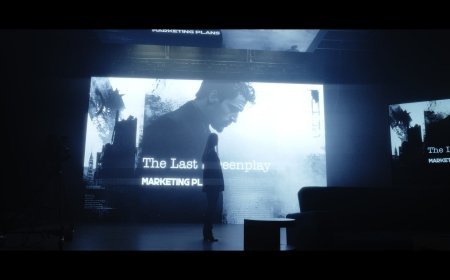
















Review: The Last Screenplay (2026)

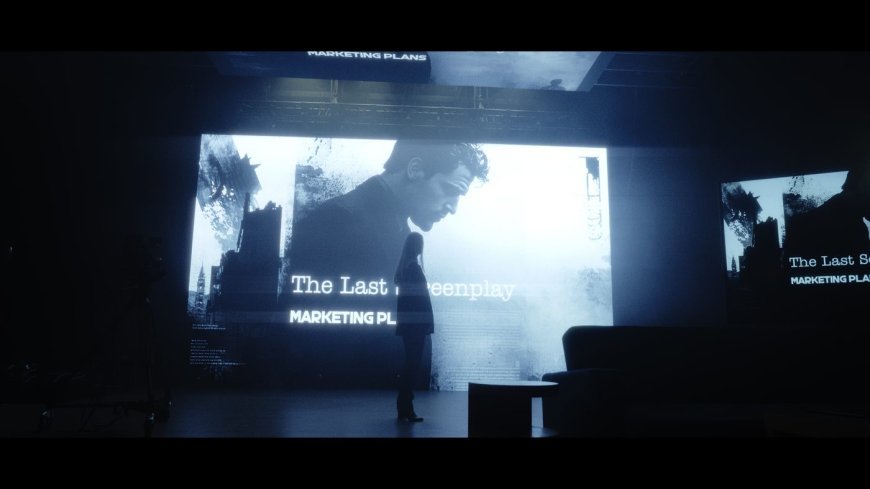
In cinema, almost anything can be repaired in post-production. A missing shot can be recreated, a disjointed sequence rearranged, and an unsatisfactory ending reconsidered. Thomas J. Ward’s The Last Screenplay takes this familiar filmmaking reassurance and turns it into something considerably more unsettling.
At its centre is Debbie Scott (Jane Lee Jones), an influencer-turned-producer determined to establish her own version of Hollywood in the English countryside. She speaks of her film studio as an ambitious creative enterprise, even as unpaid crew members, missing equipment, stalled productions, and dwindling finances suggest otherwise. Meanwhile, her relationship with Richard Wadsworth (Andrew Norman), a Hollywood editor from a bygone era whose memory is failing, becomes increasingly difficult to distinguish from the elaborate fiction she has constructed around her professional life.
Ward initially approaches Debbie’s quandary as a satire of an entertainment industry increasingly preoccupied with fame and success. Debbie has cultivated an online following and knows how to present an appealing version of herself to an audience. But the ability to command attention is not the same as knowing how to produce a feature film. Her encounters with a prospective financier expose the distance between her promotional confidence and the practical demands of filmmaking. When commercial considerations threaten her creative ambitions, she resists compromise, even though the production appears to have little left to sustain it. There is an interesting tension here between the desire to make something lasting and the pressure to remain perpetually relevant.
The film’s more affecting dimension, however, emerges through Richard and Debbie's exchanges in the editing room that carry an understated melancholy. He occasionally mistakes one production for another, loses track of meals and conversations, and struggles to recognise footage he has apparently been working on. Yet he retains the instincts of an experienced editor, speaking about scenes, cuts, and the possibilities of a film with an enthusiasm that seems untouched by his failing memory. The irony is particularly poignant. A man whose professional life has been devoted to assembling fragments into coherent narratives can no longer reliably organise the fragments of his own experience. Debbie’s attempts to protect him, and perhaps herself, lend their relationship an emotional weight that the film’s critique of the film industry might otherwise lack.
Ward translates this psychological uncertainty into an increasingly maze-like narrative. Familiar locations acquire unfamiliar meanings; conversations and scenes appear to repeat or contradict earlier events; and the distinction between what is happening and what Debbie believes is happening becomes progressively unstable. The studio’s corridors and rooms reinforce the sensation of being trapped inside a production that cannot reach its final cut. The audience is left doing something akin to an editor’s work, attempting to establish continuity from material that refuses to settle into a reliable sequence. At times, the obfuscation becomes heavy-handed, and the accumulation of mysteries risks frustrating rather than deepening our engagement.
Still, the film’s eventual revelations lend a more intimate meaning to its formal uncertainties. What initially appears to be a story about a struggling producer and an ailing editor becomes an examination of the emotional bargains people make to postpone an unbearable truth. Debbie’s insistence on finishing the film is not simply professional ambition; it is bound up with her need to give Richard a sense of purpose and to preserve what they have built together. In this respect, the screenplay’s central metaphor acquires considerable tenderness.
The Last Screenplay is not always as controlled as its conceit demands. But Ward finds something affecting in the distance between the stories we construct and the lives we actually inhabit. Sometimes, the hardest thing to accept is that there is no final edit that can make everything right.
What's Your Reaction?