



















Interview: Ishan Parikh

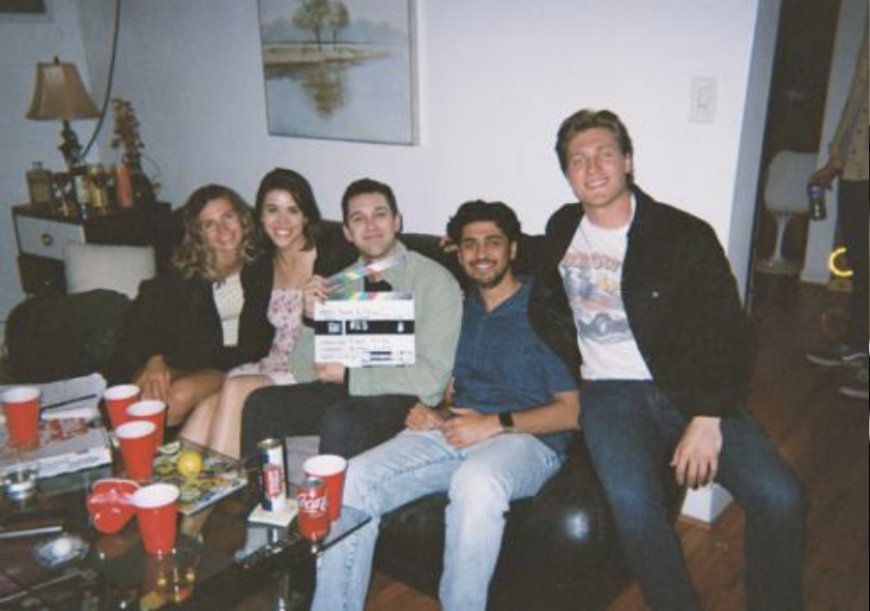
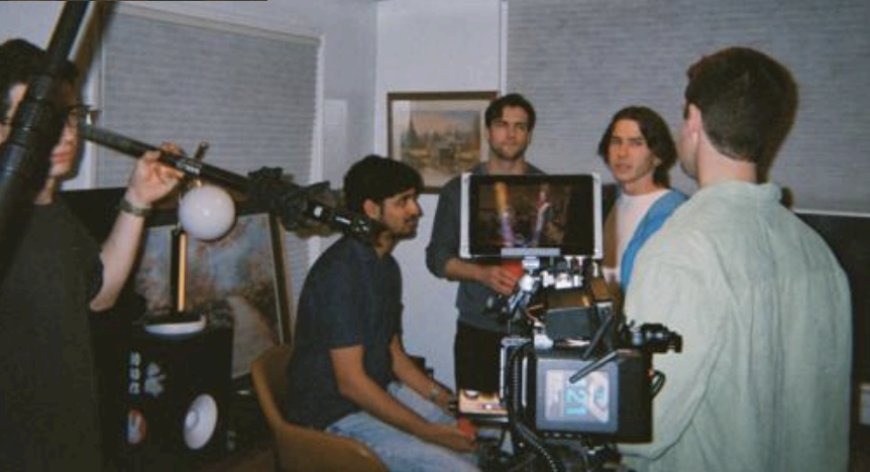
In his debut feature, People & Things, Indian-American filmmaker Ishan Parikh turns his attention to the uncertainties of young adulthood in contemporary Los Angeles. Set against a city shaped by digital culture and the pursuit of personal fulfilment, the independently produced film follows four young people navigating loneliness, romantic disappointments, shifting ambitions and the elusive promise of human connection. Drawing on his interest in character-driven storytelling and the complexities of modern relationships, Parikh examines the gap between the lives people imagine for themselves and the realities they struggle to reconcile with.
In this interview, Parikh discusses the inspirations behind People & Things, its visual language, the tensions underlying its characters’ relationships and the creative journey of making his first feature film.
Dipankar Sarkar. Was there a particular film, filmmaker or personal experience that made you realise filmmaking was the medium through which you wanted to tell stories?
Ishan Parikh. When I was really young and discovering films, I remember being really shaped by films that offered a lot of worlds like Star Wars or Harry Potter. But it wasn’t until later in my teens when I started watching more of Paul Thomas Anderson, Martin Scorsese, and Christopher Nolan’s films that I really started to pay attention to how you can explore ideas and certain concepts and imbue them with a personal sensibility through film. I’ve always been drawn to how filmmakers can put their own individual stamp on a film, and express how they see and feel the world, particularly those filmmakers mentioned above that have been able to successfully execute on a large scale and still retain their artistic integrity.
Dipankar Sarkar. Before making People & Things, you directed a couple of short films. How did those experiences shape your filmmaking sensibilities, and what did you learn from working on a smaller scale that proved valuable when making your first feature?
Ishan Parikh. Really with my body of shorts, I got to explore different tones, different genres and I got to practice building my own sense of taste, or style through them. I got to really hone in on storytelling that felt emotionally honest and how I could best convey that through writing. I’ve always written my own scripts, so for me, making a film – even the little details of sound, editing, and the different design elements – I tend to come up with a lot of those details in the writing stage. But also those shorts allowed me to get better at practical skills, like working with actors, learning to trust your collaborators, and prepping the best you can for a project. I learned that working fast, staying confident, and being able to articulate what you need/want from people pays dividends on a project – especially a feature on a low budget.
Dipankar Sarkar. Independent cinema has frequently explored heartbreak, burnout, loneliness and the search for meaning in an increasingly attention-driven digital world. What drew you to these themes in People & Things, and what did you hope to bring to them through the experiences of your characters?
Ishan Parikh. I wanted to go for an honest and unfiltered portrayal of Los Angeles and aim to show what life is like in such a vast and busy city, particularly from the youth’s perspective. I think inherently the experience of being young and in your twenties lends itself to themes that anyone can relate to whether it’s heartbreak, loneliness, confusion. These are all universal feelings. I grew up as new media really exploded into the culture. The older I get, the less I remember a time where our world was not digital. But particularly after moving to Los Angeles, I found myself noticing how inseparable digital media really is from our lives now and how rapidly the culture was both benefiting from and falling prey to it. So naturally, I very much brought that into writing this film. I felt that having media so deeply present in the characters’ lives would speak to how it’s deeply ingrained in our own lives. I think by showing how the characters use it with dating apps or whatever, how they retreat into it, or even in Leena’s case by the end of the film, she embraces it in a sense. Hopefully, the film gives you an authentic and relatable picture of where the culture is at in terms of its ongoing relationship to the digital age.
Dipankar Sarkar. Early in the film, Matt is browsing a dating app and discussing a woman’s profile with Luke when Ingmar Bergman comes up in the conversation. What prompted you to include this reference?
Ishan Parikh. Oddly enough, that came from something I actually saw on a dating app. I’ve always been interested in the way old and new sensibilities coexist, not just in Los Angeles, but particularly among young people today. It’s a generation that’s grown up immersed in digital culture, yet there’s still an appreciation for classical art, cinema, and philosophy. I find that tension is an interesting reflection of the times we live in, and I wanted to capture some of that in the film. It’s a small detail, but one that felt representative of the cultural landscape I was observing.
Dipankar Sarkar. There is a party scene in which Matt encounters three strangers and begins offering unsolicited opinions about their lives, jobs and expectations. What were you trying to convey through this encounter, beyond its humour?
Ishan Parikh. I think that goes back to the clash between an older philosophy of thinking and what people are going through today by what’s referred to as hustle culture. Matt is a character who has his career figured out, his life is pretty straightforward financially. So naturally, he’s someone who wouldn’t be in touch with the rest of the world from an economic perspective. That’s one of the things I found interesting about having him be our central character. He is the eyes of someone who hasn’t struggled like his roommate, or those partiers that he’s talking to in the scene you pointed out. His concept of “hustle culture” is practically non-existent. Through someone like Leena, we see a very different attempt at success. I wanted to show two very different outlooks on struggling for success. It’s an idea the film circles back to – this notion of planning your life for success vs chasing it, and how success fares differently for different people.
Dipankar Sarkar. Leena and Annie have a rather estranged relationship as roommates. When Leena loses money after trusting a fraudulent online account and Annie misses an audition opportunity, their ensuing argument brings their differences to the surface. How did you approach their relationship, and what did you want to reveal about the distance between them?
Ishan Parikh. I always saw Leena and Annie as estranged sisters, of sorts. It’s something that I spoke at length about with Charnie and Emily – the actors who play Leena and Annie respectively – when we would talk through the scenes, is that they’re both individuals with different mindsets and approaches to their struggles which is what that final argument between them really boils down to. Leena is swept up in this confusing wave of unemployment and of where to chart her life next – there’s a naivete and awkwardness to her character that I think Charnie brings to the surface so authentically without being unempathetic. One of the things I remember asking Emily to embrace in her performance is that Annie, despite seeming like an ignorant “LA girl,” is a hard worker, and has high expectations for herself when it comes to work. Her work matters to her. We needed the audience to latch onto that. In Leena, she sees someone who is retreating into social media with the naive hopes of sparking a career out of it, and it differs heavily from what Annie’s way of life is. I think that push and pull between the two is what feeds into that distance between them. And while it doesn’t fully get resolved by the end of the film, I think it exists to highlight how lonely these characters ultimately feel in their chase for their dreams.
Dipankar Sarkar. Towards the climax, the film takes a darker, more sinister turn, moving beyond the expectations established by its romantic and comic elements. What drew you to this tonal shift?
Ishan Parikh. It was one of the things that made me the most nervous – that shift. It was a swing. We were practically switching genres and breaking from the tone we had set. And it is asking a lot of the audience. But I felt it was dramatically necessary in terms of where the characters – particularly Matt and Leena – had to go. You have to ramp things up in your climax, as they say. In a low-stakes film like ours, there weren’t a lot of external factors that threatened these character’s lives. There were no buildings blowing up, no ticking clock. The essential question I had when writing the ending was Are these people going to be okay? Emotionally okay? And so, for me, it seemed the characters had nowhere to go but inward. That meant we had to build the climax of the film via the characters’ anxieties and state of panic, and push as far as we could into the hyperreal. I’m of course referring to that show-stopping panic attack scene that was carefully cut by my editor Chi Ogilvie and scored amazingly by one of our composers Tim Harte. It took us weeks and months to get that sequence right and Tim’s score proved to be uneasy and intense in all the right ways. It really tied everything together.
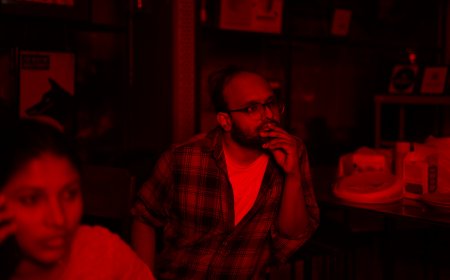
Even while shooting it, I was a bit unsure because it felt so different from how we had shot the rest of the film, and we shot the last twenty minutes of the movie relatively early on. But some of the images we were getting – like Brett’s (Matt) eye looking through the door, or using the red lighting. There was a striking quality to it all. It’s one of those things where you have to go with your instincts and lean into your choices, and trust that it’s all going to connect in the end. There was an experimental nature to it, and certainly one that Chi and I embraced in the edit. I’m pretty proud of that final panic sequence. I think it gives the film the kick it needs to really go somewhere in the final act in what’s otherwise a very dialogue heavy film. There’s an expressiveness, and impressionistic quality that sequence takes on, specifically with the cutting between Matt and those images in his head, that I wanted to get right to. Hopefully, it heightens things appropriately within the framework of our story.
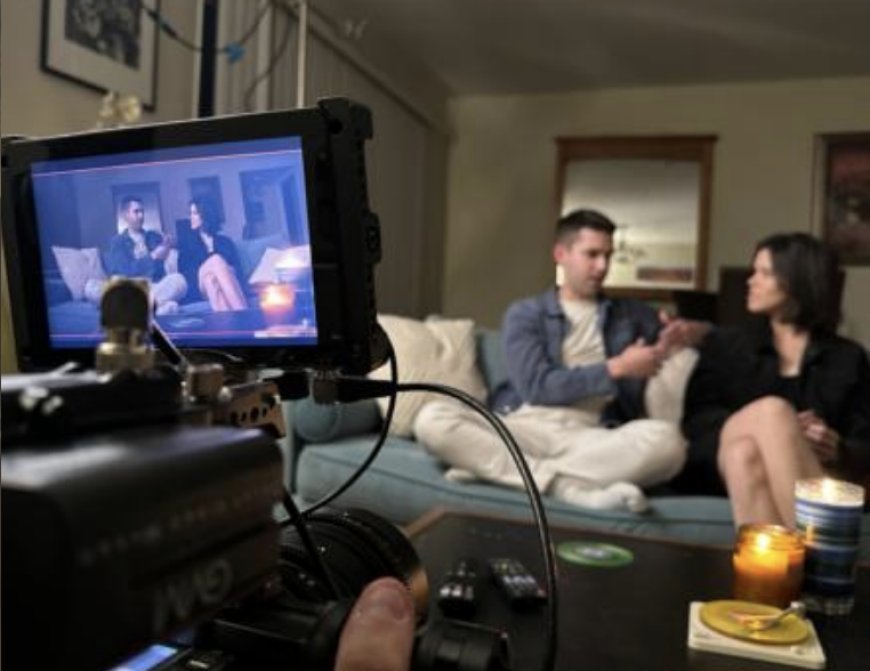
Dipankar Sarkar. The film relies heavily on medium and close-up shots, while its characters often remain confined to apartments and other enclosed spaces. How did you conceive the film’s visual language?
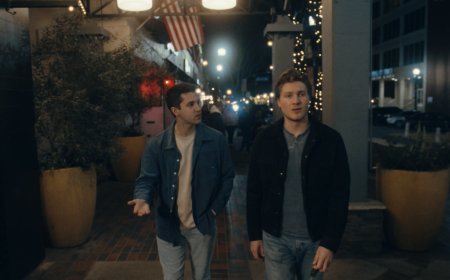
Ishan Parikh. The apartments and enclosed spaces were always going to be a challenge. The film was written to take place in enclosed places – like a “living room drama,” as someone referred to it as, which I thought was a fun way of putting it. And that inherently limits you in terms of where you can put the camera or how much space you have to play with. The only thing I could do was shoot these conversations with the lenses I felt would best keep us closest to the characters and their headspaces. Close ups really helped because we were making an intimate drama. Visually, I wanted to harken back to the films of the seventies or eighties, when the camera was mostly locked. I looked at films by Mike Nichols, like Carnal Knowledge or The Graduate for framing. But then also Richard Linklater’s Boyhood and Cooper Raiff’s Shithouse for capturing those real-life street conversations. The party scene was definitely pulled from Booksmart. I really found Tarantino’s Once Upon a Time… in Hollywood to be the best in terms of making a location a leading character. So it was all these films and seeing how they conveyed visual flavor, but then building something of our own from them that felt specific to the world of this film. A lot of it too was my cinematographer Nate Luber’s sensibilities and how he captured those medium shots and close ups. He has a keen eye for embracing surroundings and using them to your advantage, which we had to do a lot of on People & Things.
Dipankar Sarkar. Looking back at the journey of People & Things, from its conception to its release, what experience will stay with you the longest?
Ishan Parikh. So many things – from the incredible people that have been working with me for a few years now whom I was able to tie together with great people that I was working with for the first time. The thing that I’m proud of most of and will look back fondly on is working with this great cast we put together for this film. I had the pleasure of casting the core four of the main ensemble. And all of them understood what I was asking for with the material, and they really rose up to the challenge and gave it their best. It’s very rare that you get the opportunity to work with actors of this level of talent, and in People & Things I got to both work with them individually, but also together, just by nature of how our story plays out. I cannot say enough of all our actors – even the ones that turned up for a day or two and added so much to the scenes. They all have such bright careers ahead of them.
Dipankar Sarkar. Lastly, what kinds of stories would you like to explore in the future?
Ishan Parikh. Genre storytelling and fusing different types of genres has always been of interest to me. I know I’m always going to be drawn to human dramas and stories that examine relationships, but it's how you filter that through different genres on a larger scale that would be fun. Where you can take bigger, complex ideas and make them accessible through a more commercial lens. That’s always the goal.
What's Your Reaction?