




























Review: Aman (2026)

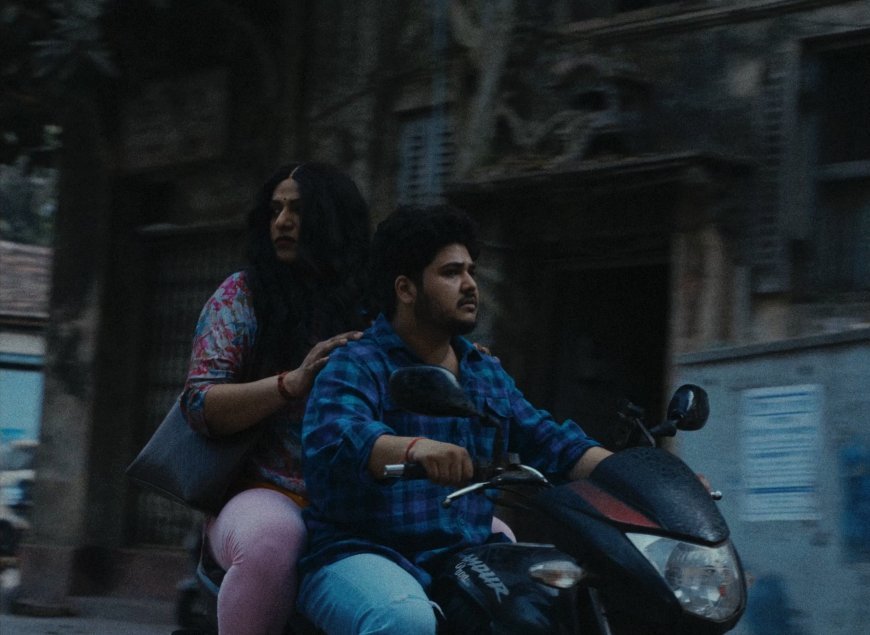
There is a particular irony at the heart of Aman, a short film that begins on the eve of a trans man’s gender-affirming surgery and takes an unexpected turn when he discovers that he is pregnant. In a society where the birth of daughters has historically prompted families to keep trying for a son, Aman’s predicament unsettles the assumptions underpinning this preference. His pregnancy is not simply a biological contradiction to his identity; it exposes the limitations of a social order that insists on making the body legible through rigid categories of sex and gender. The film finds its dramatic impetus in this dissonance, though its more compelling concerns lie in the intimate relationships surrounding its protagonist.
Aman lives with Sirat, a working trans woman whom he regards as a sister. Their relationship provides a rare space of familiarity, where neither character needs to explain or defend their existence. Sirat, who works in a hospital, is also the story’s most pragmatic presence, responding to difficult circumstances with a directness that contrasts with Aman’s growing disorientation. Their bond offers a counterpoint to his relationship with Partho, whose affection is complicated by secrecy. Partho has concealed their relationship from his family, making intimacy contingent on maintaining a public fiction. The film leaves Aman’s relationship with his family largely undefined, but a brief telephone exchange with his mother suggests a deep-seated estrangement. When she recognises his voice and abruptly disconnects the call, the rejection is conveyed without confrontation. It is a small, devastating moment, and one of several instances in which Aman trusts silence to communicate what dialogue might diminish.
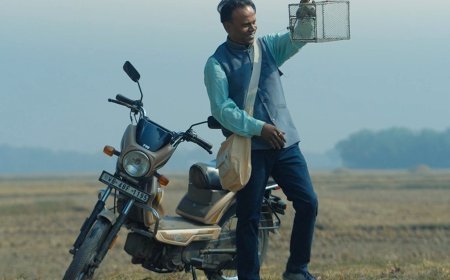
The narratives' social observations are similarly embedded in passing encounters. In one scene, Aman drives Sirat on a motorcycle and stops at a traffic signal, where a group of transgender people solicit money from motorists. The juxtaposition with Sirat’s employment at a hospital quietly gestures towards the unequal circumstances within which transgender lives unfold. Elsewhere, an elderly man’s inhibited gaze towards Sirat captures a familiar social discomfort: the impulse to look, coupled with the reluctance to acknowledge the person being observed. These moments are not developed into explicit arguments. Instead, they form a social texture around the central drama, suggesting how exclusion is sustained as much through everyday gestures as through institutional structures.
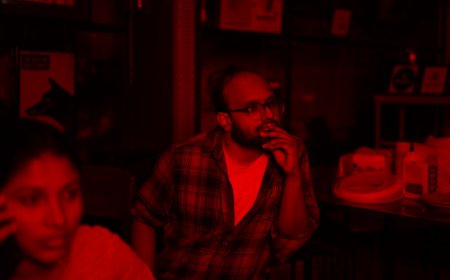
The film resists turning Aman’s discovery into a sequence of escalating revelations. It is attentive instead to the physical experience of uncertainty, repeatedly placing its protagonist in isolation. On a rooftop, Aman rolls a cigarette, his body momentarily detached from the domestic world below. Later, as he takes a pregnancy test in the bathroom, the enclosed space becomes an extension of his psychological predicament. The repetition of these solitary images allows the emotional stakes to accumulate through gestures and pauses rather than explanatory dialogue. Its dramatic method is one of accretion, in which small moments accumulate significance until the weight of the revelation becomes difficult to ignore.
Tamás Apor Méder’s cinematography reinforces this sense of enclosure. His camera stays close to the characters, often framing them through doorways, windows, and other objects that restrict the visual field. The compositions suggest lives shaped by boundaries, both imposed and internalised, without reducing the imagery to a simple metaphor. A cool, bluish colour palette lends the film an atmosphere of emotional suspension, as though its characters inhabit a world in which certainty is perpetually deferred. Anadi Athaley’s editing complements this approach. The film rarely overstays a scene, and its willingness to cut to a character’s reaction rather than preserve the continuity of an exchange gives certain moments an understated force. Adeep Singh Manki’s sound design is equally restrained, allowing ambient sounds to sustain the film’s environments without imposing an emotional interpretation.
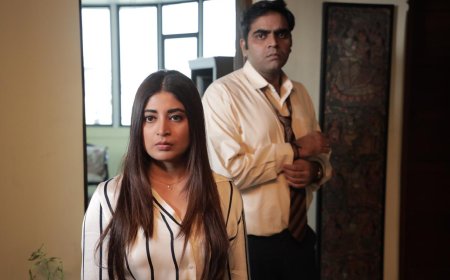
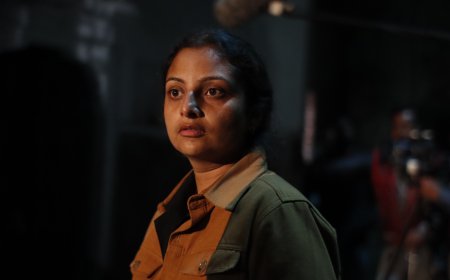
The performances operate within this register of controlled expression. Kabir Maan gives Aman a convincing mixture of confusion, vulnerability, and resolve, conveying the effort required to reconcile an unexpected physical reality with a hard-won sense of self. Guntaaj Deep Singh’s Partho has a calming presence, beneath which lies an emotionally guardedness that complicates his apparent composure. Sirat Taneja brings an appealing practicality to her character, making her the film’s most grounded character without diminishing her emotional presence. Satakshi Nandy, in a brief appearance, introduces a note of puzzlement that enriches the film’s interpersonal dynamics.
Aman is ultimately a story about love, betrayal, and trust, but its interest extends beyond the familiar tensions of a relationship tested by circumstance. It asks what happens when the body refuses to conform to the narratives through which a person has come to understand himself—and when those closest to him prove unable, or unwilling, to accommodate that uncertainty. The film’s achievement lies in recognising that identity is not made more authentic by the absence of ambiguity. Its most consequential struggle is not between manhood and biology, but between the freedom to define oneself and a world that continues to demand definitions.
Following its world premiere at TIFF 2026, Aman is set to screen at the BFI London Film Festival.
What's Your Reaction?