






































Ankur Deka’s short film, Aabiskar: The Joy of Rediscovery
Parthajit Baruah reviews Ankur Deka’s debut short film, Aabiskar.


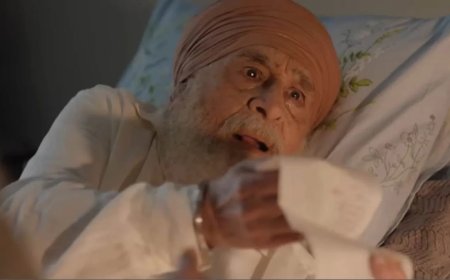
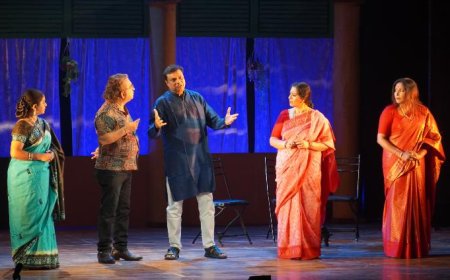
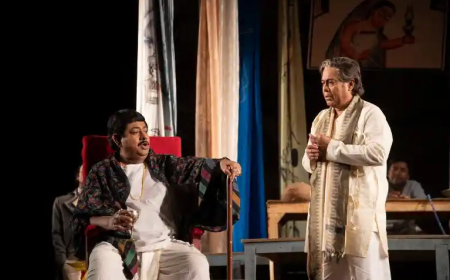
The Assamese short film Aabiskar (2025), written and directed by Ankur Deka, is 30 minutes long, but its genuine storytelling and flowing narrative make an impressive impact on me as a viewer. Set in the city of Guwahati, the story centres around Manoranjan Kalita, a retired officer who earned a reputation for honesty throughout his career. One day, while visiting a local stall to buy milk, Manoranjan is unexpectedly approached by a casting and assistant director. He is searching for an elderly gentleman with a potbelly for an Assamese film and finds Manoranjan to be the perfectly fit for the role. Initially hesitant, Manoranjan eventually agrees, recalling his days of acting in college plays.
Feeling excitement, Manoranjan rushes home to share the news with his family. His household includes his wife, his son, his daughter-in-law, a young maid, and his daughter who lives in Bangalore. Overjoyed at the hope of acting again, Manoranjan begins preparing for the role. He practises his lines, goes for morning runs, and gargles to get his voice right. Despite his enthusiasm, most of his family members, except for his daughter, the young maid, and a close friend, are not supportive of his new role at this stage in his life.
The title of the film, “Aabiskar” means “discovery”. Through the title, the screen writers may be suggesting that, just as Manoranjan is discovered for a film role, anyone can be recognized for their talents at any age. In fact, the film explores the idea of discovering one’s own passion and abilities, regardless of age. When given the script, Manoranjan learns that his character is a corrupt officer in the film. This disturbs him, and he tells his friend, “Throughout my career, I remained honest and uncorrupted; but now, I have to play the role of a corrupted officer.” His friend gently cheers him, “It is just a role and you have to enact only. It is nothing like that.” The screenplay beautifully incorporates the song “Monore Bura Roja,” using humour and emotion to show Manoranjan’s excitement and anticipation for the role.
The day of the shoot arrives. Accompanied by the young maid and his friend, Manoranjan steps into the world of cinema, surprised by the large film set. He is nervous, yet happy to be part of something new. The film concludes with Manoranjan sitting in the office room for his scene.
The story is very intimate, dealing with Manoranjan’s late-life rediscovery of his talent. The dialogues of the film carry a gentle humour, and the music is used considerately, that adds a light-hearted touch to the scenes. The editing is smooth and the cinematography gently effective. Dr. Jayanta Das as Manoranjan Kalita, and Pakija Begum as his wife, deliver natural and convincing performances. Their accents, subtly different, may well be a deliberate choice by the screenwriters to reflect real/diverse Assamese households. The supporting cast, including Kula Kuldip and Swagata Bharali, are equally strong, and the young maid’s performance stands out for its genuineness.
A title card at the end of the film reveals, “It is inspired by Patol Babu, Film Star” by Satyajit Ray. Watching Aabiskar, especially for a second time, brings to mind the heart of Ray’s story. In Ray’s original, the story is set in Calcutta. Patol Babu, who worked in a company, had to lose his job due to World War II. Oneday, he is asked to play a small role in a film because the film needs a short, bald-headed man around fifty years of age. Once accepted the role, he is given just one monosyllabic exclamation, “Oh.” Initially disappointed, Patol Babu remembers his mentor’s words: that no role is insignificant, and it is the actor who can bring meaning to even the smallest part. Inspired, Patol Babu practises and delivers the line with such truth that he wins admiration on the set.
Similarly, Aabiskar adapts Ray’s theme to Assam’s context with care. The setting is Guwahati, and unlike Patol Babu's short and bald-head, Manoranjan's potbelly is the reason that he qualifies for the role. Filmmaker, Ankur Deka’s contextualises the story in Assamese scenario that makes it unique to Assamese audiences. The soul of the film and Ray’s story remains same: the joy of creative expression and the importance of discovering oneself, no matter one’s age or background.
The brilliance of Ankur Deka and Adhiraj Kashya’s screenplay lies in its simplicity and truthfulness. They bring out the subtle humour and emotional depth of Manoranjan’s journey in a way that feels real. There is no exaggeration in the dialogue, but instead builds sweet, and believable moments.
The film shows that it is never too late to find one’s passion and try something new, no matter how old one is.
Aabiskar had its world premiere at the Kolkata International Film Festival and will be screened at SIGNS, Kerala in the focus section on February 10, 2026.
What's Your Reaction?