






























Review: Kumu – The Song of a Wingless Bird (2021)

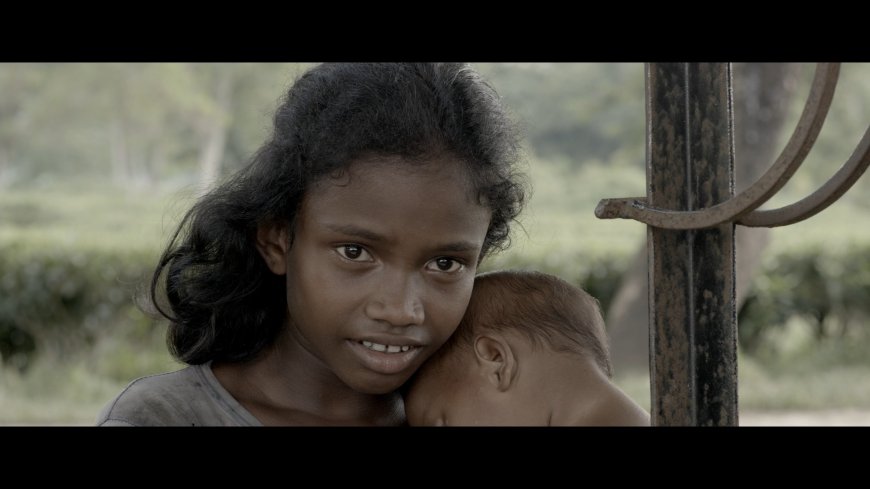
In Kumu – The Song of a Wingless Bird (2021), director Akanshya Bhagabati turns her gaze toward Assam’s tea garden community with quiet and persistent attentiveness. The film unfolds not as a social polemic but as a lament. It moves between the prosaic demands of a life deprived of choice and the fragile recognition of being born into circumstances that quietly foreclose the option to dream.
At its centre is Kumu (Nayanmoni Mura), a young girl whose desire for schooling collides with the expectations of her environment. She is forced, with matter-of-fact finality, to accept that education is unnecessary. The rhythms of domestic work and the inevitability of her fate await her instead. The conflict here is neither melodramatic nor explosive. It is systemic. The narrative understands that deprivation rarely announces itself with spectacle. It settles into routine.
The title’s image, the “wingless bird,” is not merely a decorative metaphor but a structuring principle. As she watches the rice boil in her mud kitchen at night, we hear in the background the refrain: “To which world shall I go? I find no words to explain…” The placement is telling. The domestic enclosure — smoke, flame, simmering grain — is accompanied not by silence but by yearning. The contrast is deliberate. Meanwhile, the elderly male labourers lament that they work on empty stomachs, yet cannot lay claim to the wages they have arduously earned. It is a stark reminder that groundedness here is not poetic abstraction but material condition.
What emerges is not simply the story of an individual child, but a portrait of a community historically confined by economic precarity. Money is scarce, and survival is collective, so aspiration becomes a luxury. Kumu’s father is intermittently present, habitually drunk, and abusive. He appears less as patriarch than as another symptom of a system that corrodes responsibility and tenderness alike. He returns to her wife not out of remorse, but in search of money to sustain his addiction. The domestic sphere, too, bears the marks of imbalance, where authority persists but security does not.
The film avoids reducing its characters to emblems of suffering. Instead, it observes how dreams persist, sometimes quietly, sometimes stubbornly, within constricted spaces. The lead actor, Nayanmoni Mura, brings us inside each moment with remarkable tact. Through gesture and pause, she allows us to intuit her predicament. At the same time, Bhagabati’s empathy is palpable, and her observation of the circumstances is unmistakable. Yet the film does not collapse into a slogan. Its moral force derives not from rhetoric but from accumulation and the steady exposure of inequity, until the weight of what is withheld becomes as eloquent as what is shown.
There is an austerity to the film’s emotional architecture. It does not argue. It evokes and trusts that if we look closely enough, we may begin to feel what its characters cannot always articulate. In doing so, the film becomes less a narrative of rebellion than a study of deferred possibility. The horizon remains distant, but it is never absent. It stands as a modest and affecting meditation on aspiration within confinement, conveying that even the most deprived lives generate their own sky.
Kumu – The Song of a Wingless Bird has garnered recognition at several national short film festivals. Most recently, it received the prestigious Nip Barua Award for Best Short Film at the 9th Assam State Film Awards.
What's Your Reaction?