






















Review: After the Devil is Dead (2025)

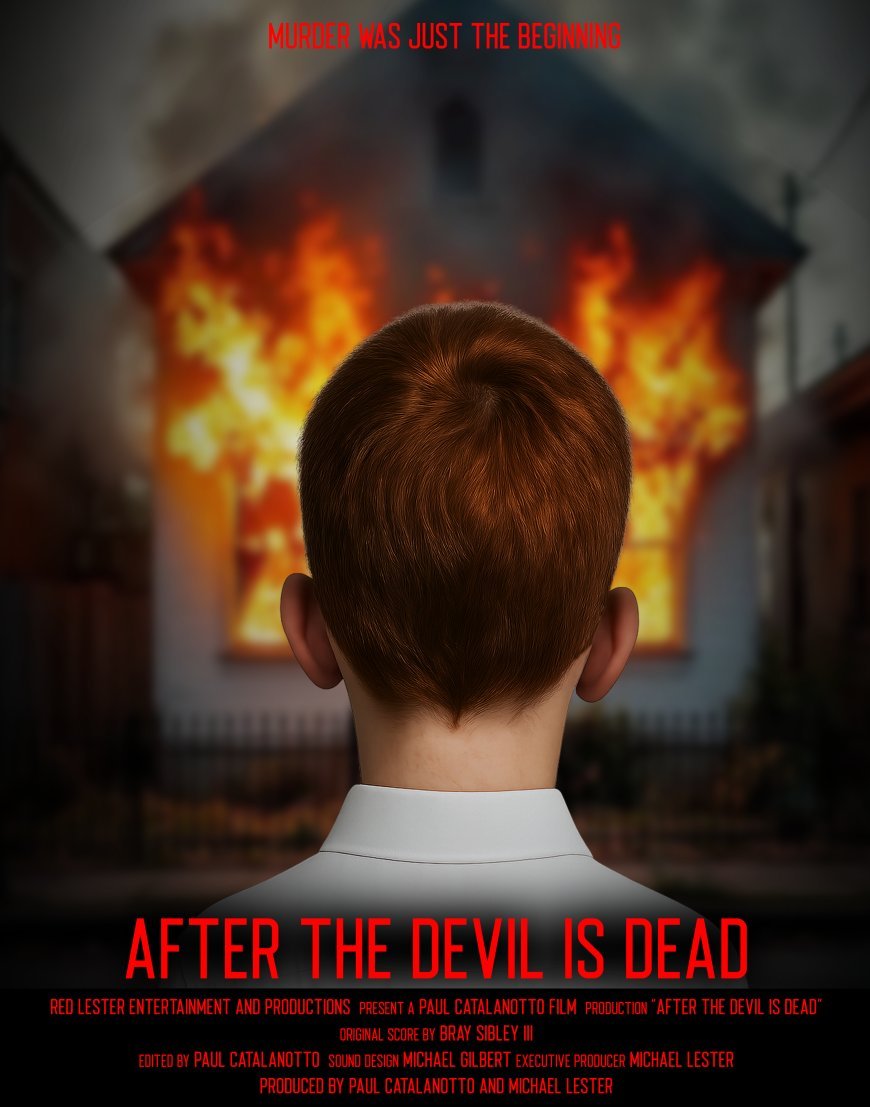
A murder can remain unsolved for forty-two years and still exert an extraordinary authority over the lives of the people who survived it. The dead person is fixed in time, and everyone else has to keep moving. Paul Catalanotto’s After the Devil Is Dead is a documentary about the 1982 murder of Edna Ann Muscarello Lester in New Orleans. The film begins with the conventions of true crime but gradually becomes interested in something more elusive: the way violence persists as memory, and how a family learns to live with what it cannot conclusively know.
Edna was thirty-two when she was stabbed inside her home, which was then set on fire. Her killer has never been identified. Four decades later, her son Michael Lester revisits the crime with a question that has apparently shadowed much of his adult life. Was his father, Russell Lester Sr., responsible?
It is an inherently dramatic question, but Catalanotto is less interested in producing a tidy revelation than in excavating the family history surrounding it. Russell, a police officer, emerges through the recollections of Michael, his sister Angela, his former wife Vickie Morgan Blum, and others as a figure of sustained domestic violence. The film accumulates these memories slowly, almost clinically. The murder may be the mystery, but the family’s experience of Russell is the evidence that gives the mystery its emotional weight.
Catalanotto’s principal archive is domestic: old photographs, home movies, family recordings and letters. Their power comes partly from their banality. In these images, people are simply being people—posing, talking, moving through the ordinary routines of childhood. But once we know what happened, the footage becomes difficult to look at innocently. Home movies, after all, were never designed to explain the past. They merely preserve it, accidentally.
One of the documentary's most affecting revelations comes when Michael recalls being taken, with his siblings, to meet a priest after his mother’s death. He remembers seeing his father crying and wondering why everyone else was crying, too. The priest eventually tells the children that their mother has died. The memory is painful precisely because of what it does not contain: a child cannot yet understand the scale of the event that will define his life.
That gap between the child who experienced something and the adult who later tries to understand it becomes the documentary's real subject. Michael’s investigation is therefore not simply forensic. It is autobiographical. He is attempting to reconcile the father he remembers, the father others describe, and the father who may have been capable of murdering his mother.
After the Devil Is Dead is more interested in consequences than revelations. Its central question is not merely who killed Edna, but what happens to the people who have spent their lives asking who did. This distinction also complicates the documentary's treatment of Russell. The documentary does not establish his guilt as a matter of fact, and it is important that it does not. What it does establish, through multiple testimonies, is the reality of the violence that his children and former wife say they experienced. In this context, the murder investigation becomes inseparable from a larger inquiry into domestic abuse. How violence can become normalised inside a household, how children adapt to it, and how its effects can remain long after the abuser is gone.
The documentary's most surprising turn comes at the end, when Michael addresses his father on camera. He acknowledges the contradiction that has presumably taken decades to articulate: Russell was capable of causing immense harm, and he was still his father. Michael says that he once feared the “monster” might somehow exist inside him, too. His eventual recognition that it does not is more consequential than any answer the murder investigation might provide.
His decision to forgive his father is equally complicated. The film does not present forgiveness as an acquittal or moral rehabilitation. Michael’s formulation is more inward. He forgives because he no longer wants to carry the anger. Justice concerns what happened; forgiveness concerns what the survivor chooses to do with what happened.
That is where After the Devil Is Dead moves beyond the familiar architecture of the unsolved-crime documentary. It begins by asking whether the past can finally be explained and ends by asking whether explanation is necessary for the living to move forward.
There is no definitive solution to Edna’s murder. Forty-two years have not produced one. What they have produced, instead, is a family of survivors with different memories, multiple emotional wounds, and ways of inhabiting the same absence. Catalanotto’s achievement is to recognise that the absence itself can be a subject.
The devil, in this case, does not have to be conclusively named for his consequences to be understood. The crime remains unresolved. Michael, finally, has found a way to move beyond it.
What's Your Reaction?