


































Review: Ek Onkar (One God, 2026)

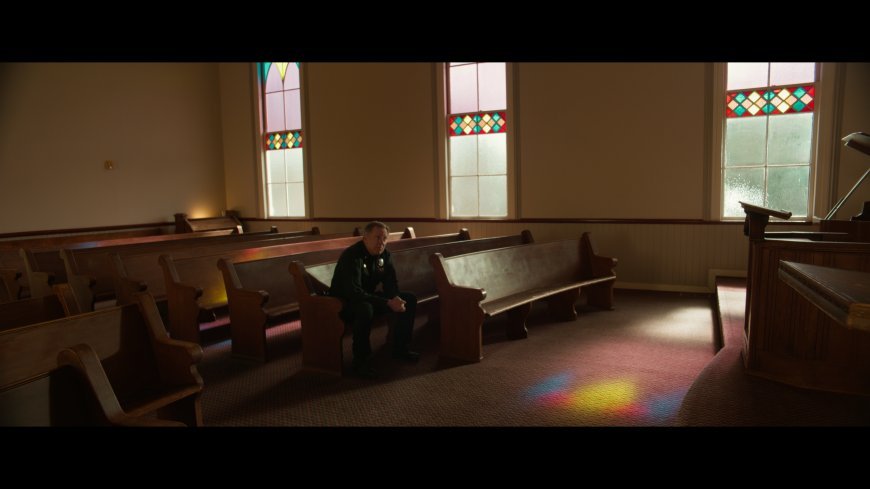
Kavi Raz’s Ek Onkar (One God, 2026) is a drama of faith and hate set against the backdrop of the 2012 shooting at a Sikh temple in Oak Creek, Wisconsin. The film explores religious prejudice, personal trauma and the possibility of redemption.
Rather than approaching the tragedy solely through the lens of religious intolerance, the film brings together three men whose lives are shaped by different forms of personal anguish. There is Chad Layton, a former Marine who has embraced white supremacist ideology; Kip Harrington, a police officer burdened by an incident from his past; and Raj Singh, a young Sikh man struggling to come to terms with his sister’s death. Their individual circumstances eventually converge around a tragedy that exposes the consequences of hatred and the fragile nature of human connection.
Of the three, Chad is perhaps the most immediately recognisable. Having experienced trauma during a military rescue operation, he turns towards an increasingly virulent form of racial nationalism. His rhetoric about reclaiming America for white people draws upon familiar strains of far-right grievance, with immigrants and minorities cast as threats to an imagined national identity. Yet the character rarely develops beyond the familiar portrait of an embittered extremist. His confrontational speeches are delivered with little subtlety, and the character lacks the psychological complexity that might have made him more compelling.
Kip, meanwhile, carries the guilt of having shot a young girl during an encounter in the line of duty. His search for some form of atonement provides another dimension to the film’s interest in personal responsibility. However, his domestic tensions are presented in rather familiar terms, rarely acquiring the emotional depth the material might have offered.
Raj’s predicament is similarly rooted in grief. Still mourning his sister, who died by suicide two years earlier, he visits a psychiatrist while struggling to resume an ordinary life. His belief that there is one God among billions of searching souls gives the film its spiritual framework. His parents, Amrik and Harinder, find purpose through their voluntary service in the gurdwara kitchen, where the communal rituals of prayer and service offer a counterpoint to the hostility unfolding elsewhere. Harinder’s growing affection for a young woman, Jasleen, also introduces the possibility of familial continuity and companionship. Yet Raj’s mourning stretches across the film without developing into a particularly revealing examination of bereavement. His sorrow often feels prolonged rather than explored.
The repeated scenes of prayers and Sikh hymns establish the importance of collective faith, but their recurrence does not always translate into dramatic movement. The film appears more interested in affirming its convictions than in examining the contradictions within them. Its screenplay frequently resorts to overt emotional cues and convenient intersections between the characters, leaving little room for ambiguity. The performances, too, are uneven, with several exchanges carrying the unmistakable weight of scripted melodrama rather than the spontaneity of lived experience.
There is an earnest idea at the heart of Ek Onkar. Faith can offer solace, while human connection might provide an alternative to the divisions sustained by prejudice. But sincerity alone cannot sustain a drama. Despite the significance of its subject and the potentially compelling intersections between its characters, Raz's film struggles to find the dramatic precision and emotional conviction needed to make its message resonate.
What's Your Reaction?