














Review: To Die a Frenchman (2026)

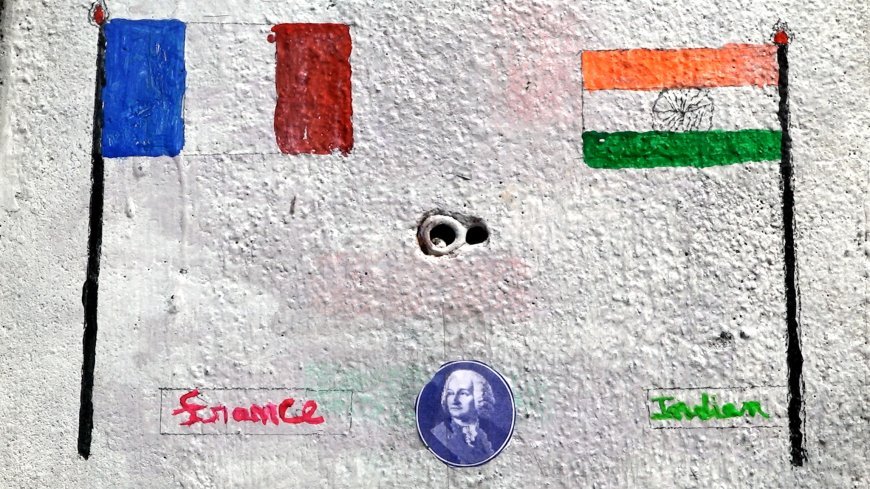
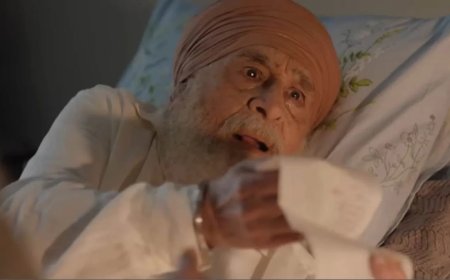
In To Die a Frenchman, Pankaj Rishi Kumar follows Monsieur Mounissamy, an elderly resident of Pondicherry who believes that French citizenship is not something he should have to ask for but something that was denied to him by history.
Born when Pondicherry was still under French colonial rule, Mounissamy belongs to a generation caught in the administrative afterlife of decolonisation. When France relinquished its Indian territories following India’s independence, residents were given the choice of retaining French nationality or becoming Indian citizens. But news of this option did not reach a wider audience and failed to reach much of the population. Many became Indian citizens by sheer margin of chance. Decades later, a small number of those who believe they were entitled to French nationality continue to contest that historical omission.
Living on a meagre pension, Mounissamy pursues French citizenship for himself, his family, and other families who, like his, were present in Pondicherry at the moment of transition. He also hopes to secure a piece of land on which he can build a house. What begins as a claim to nationality gradually becomes a struggle for the elementary conditions of dignity, including the right to have a place he can call home.
The irony is that his demands are rooted in an event more than half a century old, while the institutions he approaches appear to have little interest in correcting what they regard as an obscure administrative matter.
Kumar, who is also the cinematographer and editor, is precisely attentive to this contradiction. He does not manufacture urgency around Mounissamy’s predicament; instead, he stays with him as he moves from pillar to post, repeatedly encountering rejection, discomfort, and bureaucratic bewilderment. The camera neither instructs us to admire his determination nor asks us to pity his circumstances. It gives Mounissamy room to inhabit his own struggle.
The aural design by Kumar and Pritam Das deepens this observational quality, allowing the sounds of offices, streets, and domestic life to accumulate into an unobtrusive record of the world Mounissamy is navigating.
Mounissamy himself is a figure of considerable intrepidity. Physically frail, he becomes almost combative when confronting government officials, his determination acquiring the force of a protest that he seems unwilling to abandon even when the practical chances of success appear remote. Kumar preserves both sides of him: the idealist who imagines a future in which his claim might finally be recognised, and the determined old man who refuses to let an unanswered historical grievance disappear. This tenacity lends the documentary an atypically heroic dimension, though one that is less about victory than endurance.
The documentary's historical dimensions emerge gradually rather than through an extended exposition. Mounissamy narrates the connection to his father's involvement in the 1936 cotton-mill workers' strike, when police firing killed workers. He continues to hold the French authorities responsible for that violence.
The personal history thus opens into a longer genealogy of political memory. The colonial forces were not simply something that ended with the transfer of sovereignty but something that survives in family narratives, property relations, administrative categories, and ideas of belonging.
Nowhere is this more visible than in the division between Pondicherry's so-called White City and Black City. The former, associated with the French colonial quarter, appears affluent, orderly, and institutionally privileged, with prestigious schools and comparatively prosperous residents.
Mounissamy lives on the other side of this historical divide. The distinction is not merely architectural. The city's geography becomes a material record of the social hierarchies left behind by colonialism. The colonial distinction between European and non-European populations has outlived the political system that produced it.
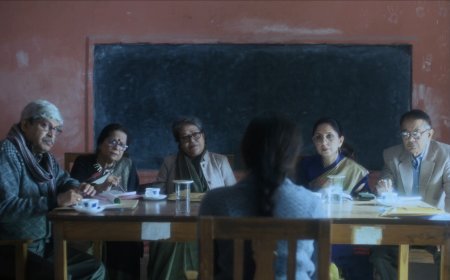
The documentary is equally attentive to the violence of bureaucracy, though it rarely depicts officials as individual villains. Their indifference is more structural than personal. Mounissamy repeatedly enters offices in search of an answer, only to encounter a system that seems incapable of acknowledging his demands. The absurdity lies precisely in this mismatch: he approaches the bureaucracy with the intensity of someone seeking redress for a historical injustice, while the bureaucracy receives him as another administrative muddle. His dispute, however, is nothing less than a Sisyphean task.
One of the documentary's most revealing moments occurs when Mounissamy visits a plot of land associated with a government settlement for people who have not obtained French citizenship. Kumar is not permitted to accompany him. The absence of the camera becomes meaningful. Rather than merely documenting the limits imposed on his subject, the scene exposes the asymmetry of access between those who administer power and those who must petition it.
What follows is an animation of the house Mounissamy imagines building on the land, a home that he intends to name after his parents. The house never materialises. Its animated existence turns it into a poignant metaphor for an aspiration perpetually deferred: a structure that can be imagined, named, and even visually inhabited, but not built.
Kumar's voice-over, along with providing historical and contextual information, also registers the filmmaker's own presence. Rather than functioning simply as explanatory commentary, it occasionally responds to the passing moments of Mounissamy's journey, allowing emotion and reflection to enter without overwhelming the images. At times, it gives the documentary a poetic quality, particularly when the distance between historical time and lived time becomes difficult to articulate through observation alone.
Yet To Die a Frenchman never turns Mounissamy's poverty into spectacle. His economic circumstances are indispensable to the narrative, but Kumar does not aestheticise deprivation in order to manufacture empathy. A small episode involving an electricity-meter reader is telling. The routine arrival of a man to check the meter and deliver the monthly bill quietly reveals how little Mounissamy and his family possess. The documentary does not need to catalogue their material deprivation. Their surroundings do the work.
Mounissamy himself articulates the simplicity of his demands when he observes that a person needs food, clothes, and a roof over his head. It is an unremarkable formulation until he recounts an incident involving his mother-in-law's death, when a landlord would not allow her body to remain inside the rented house. The indignity of that experience has stayed with him. His pursuit of French citizenship therefore cannot be reduced to a desire for a different nationality or the privileges attached to a foreign passport.
Thus, citizenship, here, becomes entangled with the question of whether a person has been allowed to possess the most basic security of place, family, and home.
This is what gives To Die a Frenchman its complexity. Mounissamy's demand may appear legally improbable and politically futile, but the documentary is less interested in adjudicating the validity of his claim than in examining the historical conditions that made the claim possible in the first place.
Colonialism appears here not as a closed chapter but as an administrative inheritance, embedded in the documents, boundaries, property arrangements, and social divisions through which people continue to negotiate their lives. Mounissamy has spent much of his life inhabiting the consequences of a colonial transition over which he had little control, and now, in his old age, tries to persuade institutions to acknowledge what he believes was his rightful place within that history.
Kumar's achievement is to resist converting this struggle into either a simple indictment of bureaucracy or a sentimental portrait of an indomitable old man. Instead, he lets the contradictions remain.
To Die a Frenchman had its world premiere in the Harbour section of the International Film Festival Rotterdam. Continuing its festival journey, the film has now been selected for the Competition section of Film South Asia in Kathmandu.
What's Your Reaction?