























Review: Weekend at the End of the World (2025)

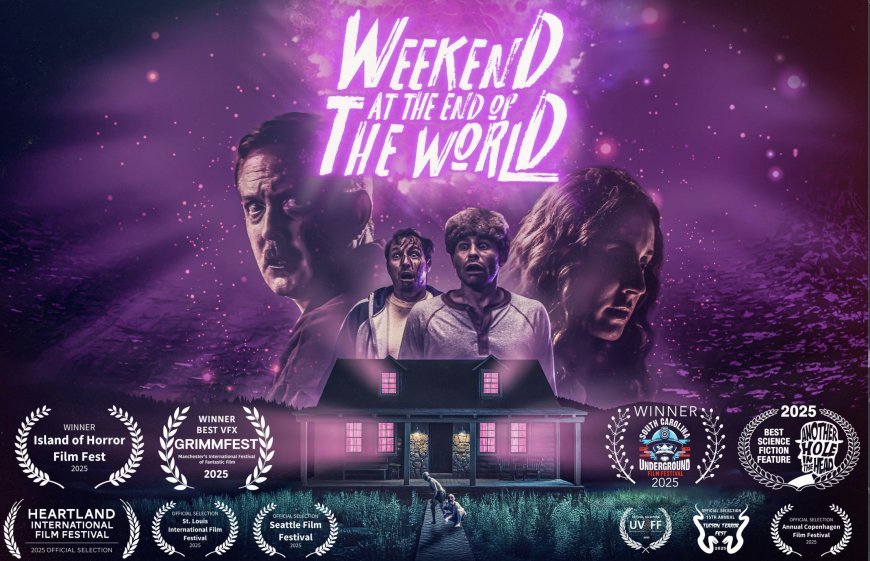
Gille Klabin’s Weekend at the End of the World begins with the familiar predicament of a man whose romantic aspirations have been thwarted and whose sense of purpose is in disarray.
Karl, devastated by his girlfriend’s rejection of his marriage proposal, retreats with his childhood friend Miles to his grandmother’s cabin, where the two hope to make a profitable property flip before the real-estate bubble bursts. It is an arrangement that promises both financial gain and emotional recovery. But the cabin has other plans.
What begins as a weekend of male bonding gradually gives way to a supernatural crisis involving a portal between realities, an undead grandmother, and the possible extinction of humanity.
The narrative approaches this collision of domestic comedy and cosmic horror with an evident appetite for tonal disruption, though the film’s ambition occasionally exceeds its ability to reconcile its competing impulses.
The premise is deliberately absurd, and the film finds much of its early energy in the friction between the protagonists’ mundane concerns and the increasingly preposterous circumstances surrounding them.
Miles, in particular, treats the impending apocalypse as an inconvenience to his entrepreneurial ambitions. His conviction that the two can save the world and still sell the cabin for a substantial profit captures the film’s satirical interest in a culture that has learned to view even catastrophe through the lens of personal advancement.
The film, in this scheme, is less an existential reckoning than an obstacle to a lucrative transaction.
The supernatural elements are similarly conceived as opportunities for comic misdirection. Meemaw, whose return from the dead is initially played for shock and irreverence, gradually emerges as the film’s most consequential figure. Her account of a life marked by successive losses introduces a more sombre register, challenging the protagonists’ assumption that suffering is an aberration rather than a condition of existence. Her conviction that darkness is not an intrusion into the world but its fundamental nature gives the film its bleakest philosophical proposition.
Yet the argument is presented less as a sustained inquiry into human suffering than as a revelation designed to propel the narrative towards its final confrontation.
The relationship between Karl and Miles provides a more recognisable emotional anchor. Their friendship, ostensibly built on years of shared history, is revealed to contain its own history of manipulation and resentment. When Karl discovers that Miles has engineered several events in his life, including the circumstances surrounding his failed proposal, the resulting confrontation exposes the self-interest beneath their professed loyalty. The exchange is among the film’s more effective sequences, allowing the comedy to give way to genuine hurt. It also complicates the familiar notion of male friendship as an uncomplicated refuge from romantic disappointment.
Working within the constraints of independent production, Klabin and his collaborators demonstrate resourcefulness in constructing a world that moves between the recognisable and the fantastical. Aaron Grasso’s cinematography and Lana Wolverton’s editing help sustain the film’s restless pace, although the shifts in genre sometimes feel more like successive tonal experiments than parts of a coherent design. Thomas Lennon, Troian Bellisario, Clay Elliott, and Cameron Fife bring an appealing sense of comic timing to their roles, lending the film’s increasingly outlandish proceedings a measure of warmth and credibility.
Weekend at the End of the World is most engaging when it allows its absurdity to expose the anxieties beneath its characters’ bravado. Its ideas about friendship, grief, and the pursuit of an idealised life are familiar, and its philosophical ambitions are not always matched by their dramatic execution.
Still, beneath the supernatural spectacle lies a modestly affecting proposition. The search for a perfect life may be less important than learning to inhabit an imperfect one. The apocalypse, it turns out, is not the only thing these men need to survive.
What's Your Reaction?