
























Review: PATH (2026)

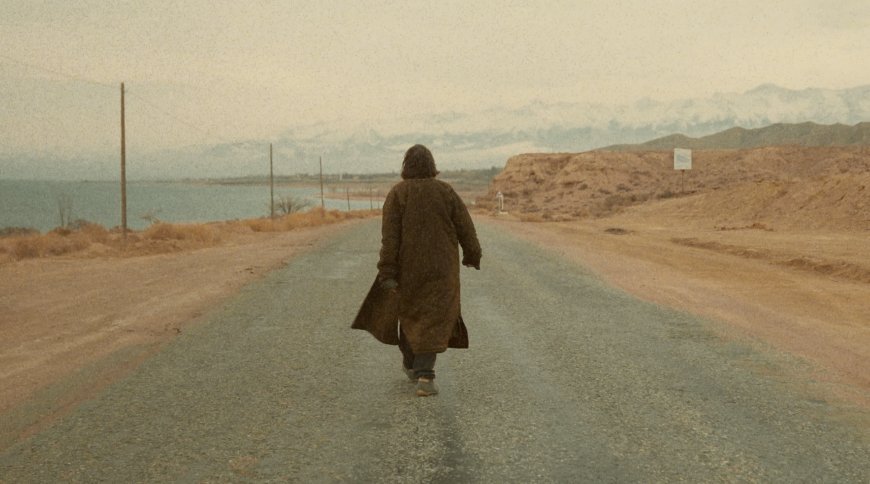
In Path, Firouz FarmanFarmaian follows the making of an artwork across borders, but the journey proves as revealing as the destination.
Firuz, a nomadic contemporary artist, sets out to create Gates of Turan, the Kyrgyz Republic’s national pavilion at the 2022 Venice Biennale. What emerges is a documentary about the precarious business of cultural representation: how traditions travel, who gets to speak for a country, and what happens when an artistic ideal encounters the practical demands of the international art world.
The documentary begins with the legend of Arash, the Persian archer whose arrow establishes a boundary between rival empires. A contemporary variation follows as Firuz sends a handwritten fax to an obscure Kyrgyz cultural official, proposing an artistic project that eventually becomes the country’s Biennale pavilion. The parallel is suggestive. Where Arash’s arrow marks a territorial limit, Firuz’s proposal opens a route across geographical and cultural divisions. Yet the film is less interested in the neatness of this analogy than in the unpredictable chain of negotiations it sets in motion.
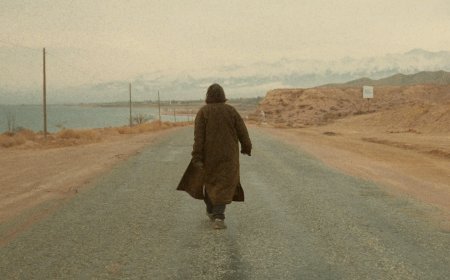
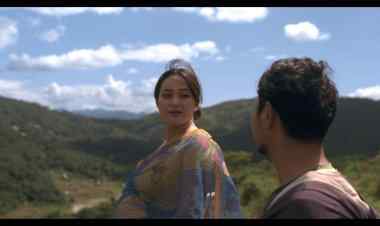
Kyrgyzstan supplies the journey with its material and historical substance. Against the immense landscapes of the Tian Shan and the expanse of Issyk-Kul, FarmanFarmaian encounters artisans whose knowledge is preserved through felt-making, textiles, and other inherited practices. The craftswomen associated with the Altyn Kol cooperative in Koshkor are particularly important. Their work is neither an ornamental remnant of a disappearing past nor simply raw material for contemporary art. It sustains livelihoods, gives women greater economic independence, and offers younger generations a reason to continue traditions that might otherwise lose their place in everyday life. The film is most persuasive when it attends to this relationship between cultural inheritance and material survival.
The collaboration is not without complications. FarmanFarmaian must navigate questions of ownership and representation, including objections to the absence of a Kyrgyz artist as the country’s representative. His insistence that he is a nomad of the planet, rather than the representative of a single national identity, expresses an appealing cosmopolitan ideal. But the distinction between artistic freedom and cultural accountability is not so easily resolved.
Path registers the tension without fully examining its implications. The artist’s mobility and international connections are themselves forms of privilege, even as his project depends on knowledge and labour rooted in a particular place.
The obstacles become more tangible when Russia’s invasion of Ukraine disrupts transport routes and closes airspace, threatening the shipment of works to Venice. Suddenly, the movement of cultural objects is subject to the same geopolitical forces that shape the movement of people. Funding shortfalls, unpaid collaborators, shipping arrangements, and diplomatic manoeuvres intrude on the artistic vision. These sequences give the film a welcome unpredictability, exposing the improvised infrastructure behind an ostensibly seamless international exhibition.
Formally, Path moves between observational documentary, travelogue, and personal essay. Its landscapes establish a sense of duration, while the music by FORRM creates an independent current of atmosphere and momentum. The film’s eventual arrival in Venice, where brightly coloured Kyrgyz textiles glow within a darkened installation, offers a striking image of cultural transmission. The traditional tunduk, a circular structure associated with the roof of a Kyrgyz yurt, becomes a focal point around which the exhibition gathers its meanings of community, ancestry, and continuity.
At times, the film’s lyrical ambitions threaten to romanticise the very connections it seeks to establish. Its faith in beauty and dialogue offers a counterpoint to an increasingly fractured world, but cultural exchange is rarely free of asymmetries. Still, Path finds something valuable in the work of making those exchanges possible. Its most compelling proposition is that tradition need not remain untouched to endure; it must find ways to sustain itself in the present. The journey to Venice matters, finally, less as a triumph of international recognition than as an account of the people, negotiations, and fragile acts of trust required to carry a culture forward.
What's Your Reaction?