

































Review: Heavy (2026)

In Heavy, a man commits a murder and then goes about cleaning it up. There is no rush, no visible panic, no explanation. He drives, carries, cleans, refuels, swims, watches television. The ordinariness of these actions is what makes them disturbing. Max Rotham’s austere debut feature film is less interested in the crime itself than in the unnerving possibility that, once violence has been committed, life can continue with barely a change in rhythm.
The film opens with extremely slow pans across empty fields, lingering on a landscape that appears to be watching without quite witnessing. Nature is everywhere within the narrative, but it offers neither refuge nor judgment. Against these expansive images, the unnamed man’s actions gradually acquire an almost ritualistic quality. Rotham, who also edits the film, is drawn to the emotional tensions concealed within the ordinary routines. With no on-screen dialogue, there is little for the viewer to hold on to except movement, gesture, sound, and duration.
What makes the viewing experience especially unsettling is how little it tells us. We never see the dead body, apart from the fleeting suggestion of a form inside a bin bag, and the film offers no motive for the killing. There is no psychological portrait of the protagonist, no flashback to explain his behaviour, and no revelation that might make the crime easier to process. His emotional blankness becomes the film’s most unnerving fact.
At around twenty-eight minutes, Rotham cuts to a close-up of the man driving his car to dispose of the body. The sequence could belong to any mundane journey. Later, when the car runs out of fuel, he has to carry a container of gasoline to it. The absurd practicality of the situation is almost more disturbing than the murder itself. A man has committed an unspeakable act, but the immediate problem is that his car needs fuel—the strange coexistence of the horrific and the ordinary that makes the moment so unsettling.
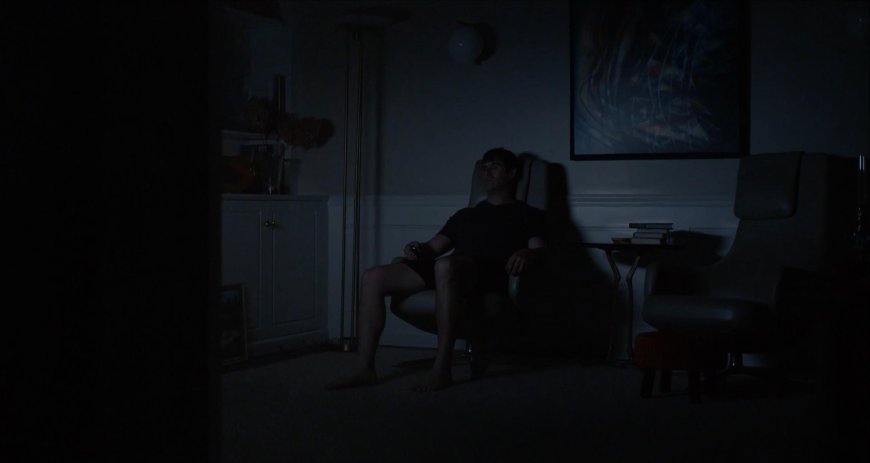
After disposing of the body, he goes swimming. Later, he sits quietly in front of the television. Rotham does not use these moments to underline the character’s depravity; instead, he leaves them strangely uninflected. This absence of overt moral judgment creates an uncomfortable distance, forcing us to observe the prosaic mechanics of a life in which something terrible has already happened. As the unnamed protagonist, Michael Ridley gives a remarkably restrained performance, conveying the character’s emotional withdrawal through the smallest gestures and the slightest shifts in expression.
Angelos Rompolis’s cinematography gives the film a striking visual expansiveness, turning fields, roads and interiors into spaces of quiet unease. Neil Benezra’s sound design is equally important, filling the absence of dialogue with ambient textures and stretches of silence. Together, image and sound make the world feel simultaneously intimate and remote.
Heavy can be demanding in its slowness, but its patience is part of its unease. Rotham understands that evil need not always arrive with spectacle or explanation. Sometimes it is simply folded into the day: a drive, a tank of fuel, a swim, a television left playing. And perhaps the most disturbing thing about the film is how quickly the landscape—and the man within it—seems to learn to carry on.
Heavy is executive produced by Mexican filmmaker Carlos Reygadas, whose involvement adds another distinctive presence to Rotham’s austere cinematic undertaking.
Heavy is streaming on Amathus Films: https://amathus.vhx.tv/videos/heavy
What's Your Reaction?