










































Review: Friends & Place (2026)

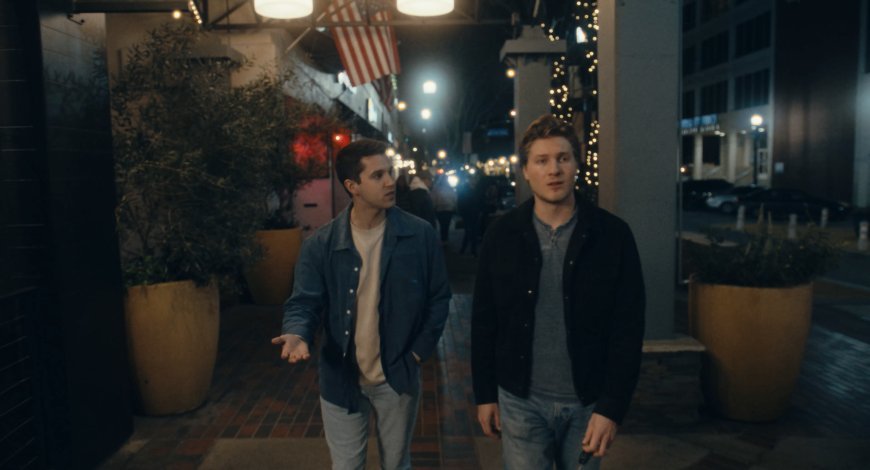
In Ishan Parikh’s People & Things, the problem with being young in Los Angeles is not so much that life fails to meet expectations as that everyone seems to regard other people as a means of improving it. This indie debut feature locates the loneliness of the digital age in a generation adept at presenting itself, evaluating others and imagining better versions of its future.
The narrative follows four twenty-somethings navigating romantic entanglements, professional disappointments and the uncertainties of young adulthood in Los Angeles. Matt (Brett Gaffney), newly single, works remotely for a Dallas-based consultancy, enjoying the security of a steady salary and retirement savings while envisioning a future of financial comfort. His roommate Luke (Andrew James Ferguson), an aspiring actor, is still trying to establish himself professionally. Meanwhile, Leena (Charnie Dondrea), a former retail manager, hopes to build a career in content creation, while Annie (Emily Mutimer), a struggling actress, pursues opportunities of her own. Their lives repeatedly intersect through romance and shared living spaces, but physical proximity rarely translates into emotional intimacy. Each is searching for a more fulfilling version of themselves, yet they struggle to understand the people closest to them. Never entirely alone, they nevertheless find themselves ill-equipped to bridge the distance between them.
Parikh’s film is interested in the distance between the lives these characters imagine for themselves and the ones they inhabit. Matt, describing his comfortable remote job, speaks of a future in which a salary, retirement savings and eventual paradise appear to offer a reassuringly complete blueprint for happiness. His certainty is faintly comic, particularly against the uncertainty governing everyone around him. Leena, meanwhile, hopes to find online a version of herself that her previous employment could not accommodate. The internet promises her an audience, a livelihood and perhaps a more legible identity. But the distinction between aspiration and delusion becomes increasingly difficult to maintain in a culture where visibility is so easily mistaken for achievement.
The film’s romantic entanglements offer another version of this predicament. Matt’s interest in Leena is complicated by the fact that she is Annie’s roommate, while Annie was having an affair with Luke, Matt’s roommate. The arrangement has the potential for farce, and Parikh makes use of its comic possibilities. Yet the film is less interested in the mechanics of romantic confusion than in the ways people use one another to negotiate their own dissatisfaction. Attraction, companionship and even casual intimacy become provisional solutions to problems that remain largely unexamined. The characters want to be understood, but often approach others as instruments of reassurance.
This contradiction becomes especially apparent in the confrontation between Leena and Annie. After Leena loses money to a fraudulent online account, Annie responds with exasperation rather than sympathy, questioning her roommate’s judgment and her prospects of succeeding as a content creator. Leena retaliates by exposing the frustrations beneath Annie’s apparently more conventional life. Their argument reveals that the women’s shared domestic space has concealed a considerable emotional distance. Each believes she understands the other, but their familiarity has hardened into a form of mutual surveillance. They know enough to wound one another, not enough to offer genuine comfort.
A similar rupture develops between Matt and Luke, whose friendship deteriorates into an argument over money, loyalty and romantic judgment. Here, too, the film suggests that resentment accumulates beneath the rituals of everyday companionship until an apparently minor disagreement becomes an indictment of an entire relationship. Parikh understands how precarious these arrangements can be, although his characters sometimes articulate their grievances with a bluntness that leaves little for the audience to discover. The dialogue occasionally explains the emotional stakes that the performances and situations have already established.
The film’s movement between comedy, romantic uncertainty and a darker, more confrontational register gives it an appealing unpredictability, even when its narrative begins to lose cohesion. Gaffney, Ferguson, Dondrea and Mutimer lend their characters enough vulnerability to keep their self-absorption from becoming wholly alienating. Parikh is also perceptive about the peculiar loneliness of digital life. Where connection is everywhere available, yet meaningful connection remains stubbornly elusive.
People & Things does not radically reinvent the familiar portrait of disaffected young adults. Its insights are more modest, emerging from the friction between ordinary ambitions and the disappointments that accompany them. What distinguishes the film is its attention to the small cruelties through which people protect themselves from their own uncertainty. Its characters spend much of their time trying to work out what they want from life, but the more uncomfortable question is whether they can recognise what others need from them. In Parikh’s Los Angeles, the answer remains uncertain.
What's Your Reaction?